![[personal profile]](https://www.dreamwidth.org/img/silk/identity/user.png) circular_time
circular_timeThis is me and new Who (and classic Who season 22 through 25):
For example, Missy. I adore Gomez' portrayal. She's like Anthony Ainley in drag, and she's magnificent. I love her sass and asides and genius and evil and charisma and camp. I love that zany combination of ruthlessness and brilliance. The whole scheme to catch Clara's attention and draw her to a parley? Fantastic. Yet I also burst out laughing whenever Missy shows up and steals the show, and I'm still laughing even when she's killing people. That's...bad, because it means I've become emotionally disconnected from what's happening.
Delgado!Master was more chillingly believable. I miss his sanity. Vaporising random security guards seems less emotionally devastating, partly because the new show flings such high violence and body counts at us that we barely register redshirt deaths, partly because the old show tried to show the Master's victims as people first — Auntie Vanessa, an innocent bobby — and then show their shrunken corpses. Ouch.
Also, despite Missy's insistence that her love-hate relationship with the Doctor isn't love (ha) and isn't sexual, she keeps making sexual remarks. This is something that's a staple of new Who, but I still find it distracting: dog's unmentionables, "saucy," "I should shoot you in a jealous rage-- wouldn't that be sexy?" and so on. It's like gender was irrelevant for the Master until she became a she, but now she's going to harp on it, as if male were the default and female is inflected. What's with the "girl talk", men and their vehicles, and the gender-coded "I'll scratch his eye out" over a rival? And why "Missy," a diminuative? Romana did and does go by "Mistress," and it's a dignified title, not necessarily evoking images of BSDM.
TL;DR: I love Missy's hilarious camp, but I mourn not being able to take the Master seriously any longer.
That started ages ago, of course. Really, it started with Time and the Rani, when the Master randomly survived being vaporised without explanation. That erased the emotional impact of Five watching the Master die. From then on, the Master's death had all the emotional punch of a cartoon 16-ton anvil falling on Wile E. Coyote: we knew he'd be back.
Which was the main problem with this episode. Missy reminds us right at the start that Who character deaths can be retconned without any logical justification whatsoever. That sapped the traumatic emotional impact of seeing Missy, the TARDIS and Clara vaporised before our eyes. We feel for the Doctor, but we're expecting a retcon. Compare that to the drama of Earthshock when it first aired — totally unexpected, and the FX were so very basic, but we sat watching the silent credits at the end in total shock, and anyone who saw it is still traumatized 30 years later. Thankfully, Capaldi's agonised acting nearly sold the horror despite the retcon problem, but it's a problem. (I also worry about children watching; Doctor Who used to be for the whole family).
More generally: New Who keeps relying on electroshock "THIS HAS NEVER HAPPENED BEFORE!!!" moments to stir the audience's emotions, but it's like the boy who cries wolf: do it too many times, and we stop being impressed. Also, New Who keeps escalating the "OMG!" moments and packing more and more of them into a story (Death in Heaven was full of so many that there was no time to process any of them). The more Who relies on electroshock storytelling, the more it feels like a roller coaster ride or a cartoon, losing some emotional depth.
Okay. Enough ranting. Here's the things I did like.
Capaldi. Capaldi Capaldi Capaldi. He's a very believable Doctor, just as Paul McGann was in the Doctor Who movie. That entire scene with Twelve telling stupid Dad Jokes and running away from facing grim truths and inviting all of his past selves to be there for his own wake and saying goodbye to Missy and Clara was great stuff. His Davros scenes were gripping and powerful. I feel like this is the first time Capaldi has been allowed to give us his take on the Doctor.
The weird snake alien was creepy and amazing. I loved his Roomba-ing from Mos Eisley to Bespin trying to find the Doctor. I absolutely adored that moment when the Sisterhood of Karn sheltered the Doctor, but the High Priestess then turned around and bawled him out like a truant child. (I hope everyone who has BBC America watches the Brain of Morbius when it airs on Thurs 9/24 at 10AM).
Clara called out of her classroom by UNIT had that farcical superhero-movie unreality which has infected New Who so much, but it was still fun. It's always good to see Kate Stewart. The "oo ah" gimmick to draw us into the episode, the frozen planes, were a simple but powerful visual. I enjoyed watching Clara and friends efficiently and intelligently figure out what was going on and take action with the Doctor nowhere around.
Skaro. I haven't seen the other Dalek episodes of new Who apart from Dalek, so I'm not quite sure how they dealt with Skaro's destruction by the Seventh Doctor, but whatever — as soon as Missy stepped outside and announced it was the ground, I realized with a thrill where they were. Skaro! I love the fact that the spot where Davros came to die was the same bleeping city we saw all the way back in The Daleks, when the Doctor, Ian, Susan and Barbara first gazed out across the city. That was a wonderful way of doing callbacks for those who remember the old days that wouldn't be intrusive to those who don't.
I'm of two minds about new Who going back and tackling the child backstories of everybody, but the young Davros scene was effective (and powerful, probably the best part of the whole story, forcing the Doctor to grapple with an unanswerable ethical dilemma). The older Davros scene was also excellent. I swore that was still Terry Molloy in there. The callback sound clips from past Doctors were well-chosen.
I listed all the sound clips here, in their original context, because they add so much depth to that scene. (I'm a little disappointed nobody reblogged that post.) They piece together the long, difficult ethical journey the Doctor has made to reach the moment when he really is willing to kill a child. Or is he?
Will he be able to pull the trigger where Four and Five couldn't? We'll see.
Aside: I just went and listened to a middling classic Who audio, The Shadow of the Scourge, and I was struck by how much more cohesive it was, trusting the audience to be able to maintain their attention for more than five minutes at a time instead of presenting story as a string of related but independent set pieces.

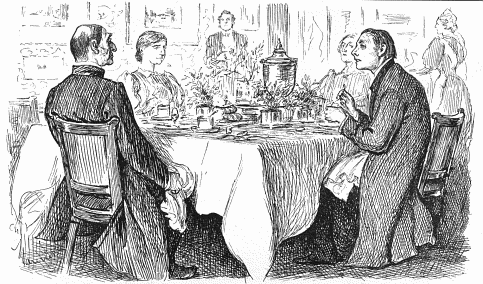
Bishop: "I'm afraid you've got a bad egg, Mr Jones"; Curate: "Oh, no, my Lord, I assure you that parts of it are excellent!" "True Humility" by George du Maurier, originally published in Punch, 9 November 1895.
I often experience this weird love-hate dichotomy with new Who, in which I simultaneously enjoy and am aggravated by the exact same thing. So I simultaneously loved and was frustrated by an awful lot of this episode.For example, Missy. I adore Gomez' portrayal. She's like Anthony Ainley in drag, and she's magnificent. I love her sass and asides and genius and evil and charisma and camp. I love that zany combination of ruthlessness and brilliance. The whole scheme to catch Clara's attention and draw her to a parley? Fantastic. Yet I also burst out laughing whenever Missy shows up and steals the show, and I'm still laughing even when she's killing people. That's...bad, because it means I've become emotionally disconnected from what's happening.
Delgado!Master was more chillingly believable. I miss his sanity. Vaporising random security guards seems less emotionally devastating, partly because the new show flings such high violence and body counts at us that we barely register redshirt deaths, partly because the old show tried to show the Master's victims as people first — Auntie Vanessa, an innocent bobby — and then show their shrunken corpses. Ouch.
Also, despite Missy's insistence that her love-hate relationship with the Doctor isn't love (ha) and isn't sexual, she keeps making sexual remarks. This is something that's a staple of new Who, but I still find it distracting: dog's unmentionables, "saucy," "I should shoot you in a jealous rage-- wouldn't that be sexy?" and so on. It's like gender was irrelevant for the Master until she became a she, but now she's going to harp on it, as if male were the default and female is inflected. What's with the "girl talk", men and their vehicles, and the gender-coded "I'll scratch his eye out" over a rival? And why "Missy," a diminuative? Romana did and does go by "Mistress," and it's a dignified title, not necessarily evoking images of BSDM.
TL;DR: I love Missy's hilarious camp, but I mourn not being able to take the Master seriously any longer.
That started ages ago, of course. Really, it started with Time and the Rani, when the Master randomly survived being vaporised without explanation. That erased the emotional impact of Five watching the Master die. From then on, the Master's death had all the emotional punch of a cartoon 16-ton anvil falling on Wile E. Coyote: we knew he'd be back.
Which was the main problem with this episode. Missy reminds us right at the start that Who character deaths can be retconned without any logical justification whatsoever. That sapped the traumatic emotional impact of seeing Missy, the TARDIS and Clara vaporised before our eyes. We feel for the Doctor, but we're expecting a retcon. Compare that to the drama of Earthshock when it first aired — totally unexpected, and the FX were so very basic, but we sat watching the silent credits at the end in total shock, and anyone who saw it is still traumatized 30 years later. Thankfully, Capaldi's agonised acting nearly sold the horror despite the retcon problem, but it's a problem. (I also worry about children watching; Doctor Who used to be for the whole family).
More generally: New Who keeps relying on electroshock "THIS HAS NEVER HAPPENED BEFORE!!!" moments to stir the audience's emotions, but it's like the boy who cries wolf: do it too many times, and we stop being impressed. Also, New Who keeps escalating the "OMG!" moments and packing more and more of them into a story (Death in Heaven was full of so many that there was no time to process any of them). The more Who relies on electroshock storytelling, the more it feels like a roller coaster ride or a cartoon, losing some emotional depth.
Okay. Enough ranting. Here's the things I did like.
Capaldi. Capaldi Capaldi Capaldi. He's a very believable Doctor, just as Paul McGann was in the Doctor Who movie. That entire scene with Twelve telling stupid Dad Jokes and running away from facing grim truths and inviting all of his past selves to be there for his own wake and saying goodbye to Missy and Clara was great stuff. His Davros scenes were gripping and powerful. I feel like this is the first time Capaldi has been allowed to give us his take on the Doctor.
The weird snake alien was creepy and amazing. I loved his Roomba-ing from Mos Eisley to Bespin trying to find the Doctor. I absolutely adored that moment when the Sisterhood of Karn sheltered the Doctor, but the High Priestess then turned around and bawled him out like a truant child. (I hope everyone who has BBC America watches the Brain of Morbius when it airs on Thurs 9/24 at 10AM).
Clara called out of her classroom by UNIT had that farcical superhero-movie unreality which has infected New Who so much, but it was still fun. It's always good to see Kate Stewart. The "oo ah" gimmick to draw us into the episode, the frozen planes, were a simple but powerful visual. I enjoyed watching Clara and friends efficiently and intelligently figure out what was going on and take action with the Doctor nowhere around.
Skaro. I haven't seen the other Dalek episodes of new Who apart from Dalek, so I'm not quite sure how they dealt with Skaro's destruction by the Seventh Doctor, but whatever — as soon as Missy stepped outside and announced it was the ground, I realized with a thrill where they were. Skaro! I love the fact that the spot where Davros came to die was the same bleeping city we saw all the way back in The Daleks, when the Doctor, Ian, Susan and Barbara first gazed out across the city. That was a wonderful way of doing callbacks for those who remember the old days that wouldn't be intrusive to those who don't.
I'm of two minds about new Who going back and tackling the child backstories of everybody, but the young Davros scene was effective (and powerful, probably the best part of the whole story, forcing the Doctor to grapple with an unanswerable ethical dilemma). The older Davros scene was also excellent. I swore that was still Terry Molloy in there. The callback sound clips from past Doctors were well-chosen.
I listed all the sound clips here, in their original context, because they add so much depth to that scene. (I'm a little disappointed nobody reblogged that post.) They piece together the long, difficult ethical journey the Doctor has made to reach the moment when he really is willing to kill a child. Or is he?
Will he be able to pull the trigger where Four and Five couldn't? We'll see.
Aside: I just went and listened to a middling classic Who audio, The Shadow of the Scourge, and I was struck by how much more cohesive it was, trusting the audience to be able to maintain their attention for more than five minutes at a time instead of presenting story as a string of related but independent set pieces.


no subject
Date: 2015-09-21 12:43 am (UTC)Overall I enjoyed this episode. While I wasn't too crazy about Twelve during most of last season, he's grown on me. And like you, I love Gomez's portrayal of the Master but can't completely take her seriously. My favorite parts were definitely all the Classic Who references and the Doctor's Medieval shenanigans. A major problem I had was that the first half felt too dragged out.
no subject
Date: 2015-09-21 12:56 am (UTC)...hm. Yes, there was an awfully long lead-up to finding the Doctor, wasn't there? I appreciated the opportunity to have Missy and Clara establish a truce and work together, but that was slow.
(On the other hand, I think without the first part— particularly Clara talking Missy into not killing people— Clara didn't have enough to do in this script.)